
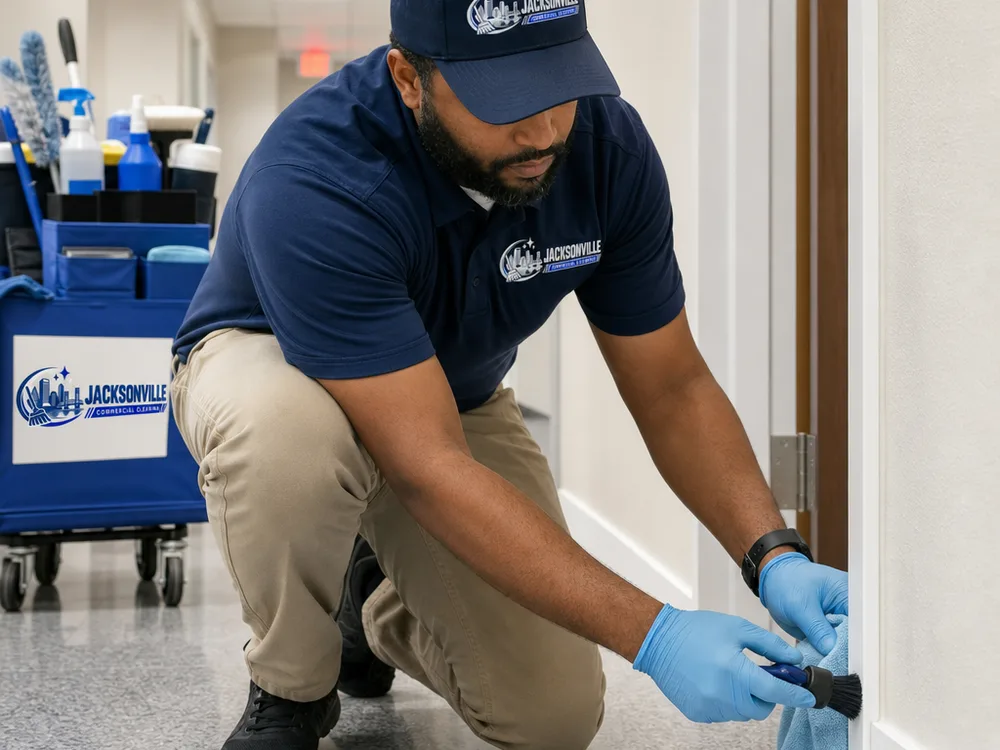
Technician detail-cleaning baseboards and door frames in a commercial hallway
Discreet after-hours work

Financial Institution Cleaning Jacksonville FL

A branch has to look composed and stay secure while being cleaned. We work after hours under agreed access and escort rules, keeping lobbies, teller lines and vestibules sharp without touching anything restricted.

✓Vetted after-hours access
✓Lobby and glass detail
✓Vestibule upkeep
✓Restricted area boundaries
Trust shows in details

Branch cleaning that respects security

A bank lobby carries a quiet argument about competence. Streaked glass, dusty window ledges, scuffed flooring near the teller line and a tired restroom all undercut the impression a branch is built to create, and customers register them while waiting with nothing else to look at.

The complication is that the building is also a secure site. Cleaning happens outside business hours in most branches, which means keys, alarm codes, camera coverage and often an escort arrangement are part of the service rather than an afterthought. Crews need to know which rooms are available, which doors stay shut and who to call before anything unexpected is touched. Those rules come from your security officer and are written into the scope.

Vestibules and ATM surrounds sit awkwardly between those two concerns: fully public, exposed to weather, unsupervised at every hour, and the part of a branch customers actually use most often. They tend to decide the impression a location makes long before anyone walks into the lobby.

Request a Callback
Branch area by area

What branch cleaning covers

What this covers in practice, from lobby glass and entrances, teller line and counters through the rest of the list below, each with the detail that matters on site.

Request a Callback

Lobby glass and entrances

Entrance doors, sidelights, interior glass and the window ledges customers stand beside collect handprints and dust that bright lobby lighting exposes. Both faces, frames and thresholds get worked, since the entrance is where a visitor's impression is set.
Teller line and counters

Counters, transaction surfaces, pens, partition glass, the floor at the queue and the kick plates below the line take continuous contact and show wear quickly. Detail work here keeps the busiest few square yards of the branch looking maintained.

ATM areas and vestibules

Vestibules are exposed to weather and used at every hour without supervision, so flooring, glass, screens, surrounds and waste receptacles need frequent attention. Tracked-in grit and discarded receipts are what make an otherwise good branch look uncared for.

Offices and meeting rooms

Private offices and consultation rooms where customers sit down for longer conversations get detail treatment: surfaces, chair arms, glass, floor edges and the dusting that shows under task lighting. Paperwork and anything on a desk stays untouched.

Restrooms and staff areas

Staff and customer restrooms, break rooms and kitchenettes receive the same standard as the public space. Fixtures, mirrors, dispensers, floors and grout get worked properly, with restocking recorded so nothing runs short between visits.

Floors under constant queuing

Queue lanes and entrance paths wear faster than the rest of a branch floor. Maintenance concentrates there with the method matched to the surface, whether that means burnishing resilient flooring, maintaining stone or extracting carpet tile in the waiting area.

Security rules first

How a branch scope is agreed

Access governs everything in a branch, so the scope begins with your security requirements rather than the task list. Which crew members may enter, how they are vetted and identified, what alarm and key procedure applies, whether an escort is present, which rooms are off limits and who is called if something looks wrong all get recorded before any cleaning frequency is discussed.

The task list then follows whichever areas are available to a crew. Lobbies, teller lines, offices, vestibules and restrooms sit on a recurring frequency, with periodic work covering floors, high surfaces and the fuller glass detail.

Vaults, secure storage, cash handling areas and anything else your policy restricts stay outside the scope entirely. The document names each one, so that a crew never has to interpret a closed door for itself or make a judgment call about access on your behalf.

Request a Callback
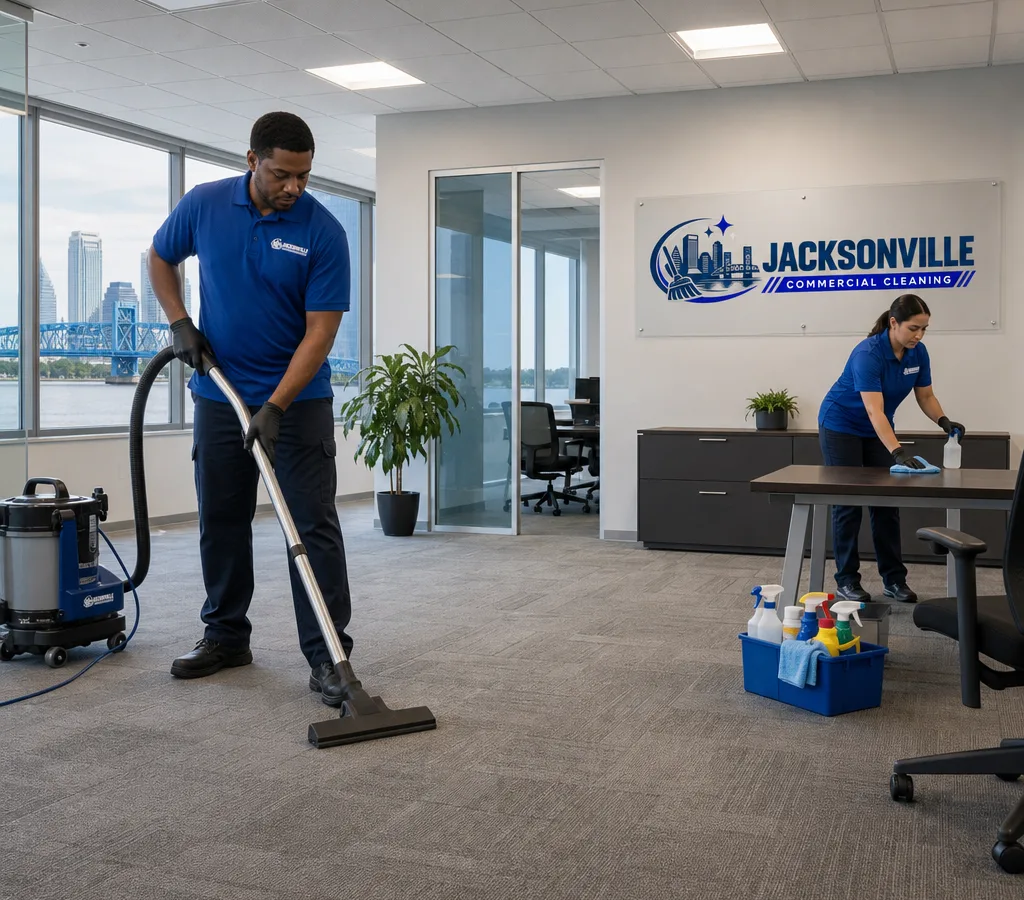
Commercial cleaners vacuuming and wiping high-touch surfaces in a modern Jacksonville office suite
Clearing access first

Starting service at a branch

What this covers in practice, from meet your security officer, define restricted boundaries through the rest of the list below, each with the detail that matters on site.

Request a Callback
01

Meet your security officer

The first conversation covers vetting, identification, alarm and key handling, camera coverage, escort expectations and which areas are available. Cleaning frequency is not discussed until those answers exist in writing.

02

Define restricted boundaries

Every room is marked available or restricted, with the restricted list explicit. Crews are briefed to treat an unmarked closed door as restricted and to call rather than open it, which removes judgment from the situation entirely.

03

Set the after-hours window

Service is scheduled once the branch has closed and balanced, fitting around staff departure, alarm setting and any escort availability. Keeping that window fixed makes arrival predictable and anything unusual immediately obvious.

04

Assign a consistent crew

The same vetted crew works the branch wherever possible, which matters more here than elsewhere. Familiar faces, known procedures and fewer access approvals make the arrangement simpler for your operations team to manage.

05

Review condition and access

Supervisor checks cover both the cleaning standard and whether access procedures are being followed exactly. Findings go to your branch contact, together with anything the building needs from maintenance.

Branches we service

Branch cleaning around Jacksonville

Branch work spreads across the city because the branches do. Downtown carries corporate offices and larger banking floors with longer queues and more glass. Suburban branches sit inside the Southside and Baymeadows office and retail corridors, Mandarin, Arlington and Orange Park bring neighborhood locations with drive-through lanes and vestibules, San Marco and Riverside put branches into older buildings, and Jacksonville Beach adds coastal sites where salt attacks entrance hardware.

Branch format changes the work as much as size does. A location with a drive-through lane and an all-hours vestibule needs frequent exterior-facing attention that an inline branch inside a retail corridor simply does not.

Institutions running several locations can hold a single scope across all of them and keep standards consistent from branch to branch through our janitorial services.

Access shapes the cost

What branch cleaning costs in Jacksonville

A branch quote rests on the area available to cleaning crews, the amount of glass, restroom count, vestibule and drive-through exposure, and the frequency your operation wants. Access requirements carry real weight too, since vetting, escorts and alarm procedures all add time to every visit.

Where that lands then depends on how many locations share the scope, how tight the after-hours window is, whether an escort must be present, the floor types in use, and the periodic glass and floor work attached. Your security officer walking it with us settles the number.

Request a Callback
Access and discretion

Questions from branch operations teams

Answers to what buildings ask before they arrange a walkthrough, covering scope, scheduling and how the work gets checked.

How do you handle keys and alarm codes?

To whatever procedure your security team specifies, recorded in writing before service begins. That typically covers who holds access, how it is issued and withdrawn, what happens when a crew member changes, and the escalation path if an alarm activates. Crews follow the documented procedure rather than any convention of ours.

Can crews be vetted to our standards?

Your institution sets the vetting requirement and we work to it, with the arrangement agreed during onboarding. Most branches also want a consistent crew rather than rotating staff, which reduces the number of people needing approval and makes access administration simpler.

What happens with restricted areas?

They sit outside the scope and are listed explicitly. Crews are instructed that any closed door not marked available is treated as restricted, and that they call your contact instead of making a judgment. Vaults, cash handling areas and secure storage are never included.

Do you clean during business hours?

Rarely, and only where a branch specifically wants daytime attention for the vestibule or restrooms. Standard arrangement is after close, once the branch has balanced and staff have left, because that keeps customer experience and security simpler for everyone involved.

How often do ATM vestibules need cleaning?

More often than the branch interior. They are used at all hours without supervision, open to weather, and the first thing a customer sees arriving after close. Many institutions want daily attention there even where the branch interior runs on a lighter cycle.

Will anything on desks be touched?

Paperwork, screens, files and anything else on a work surface are left exactly as found, and the routine is written so crews clean around them rather than moving them. Desk surfaces are addressed only where your policy explicitly allows it and staff have cleared the area first.

Start with your access rules

Bring your security requirements and branch list to a walkthrough. We will clear the access questions, mark every restricted area and then set a standard your lobbies can hold.

Request a quote

Tell us about your facility

Send the building type, the areas that matter most and your preferred service window, and we will follow up to arrange a walkthrough.