
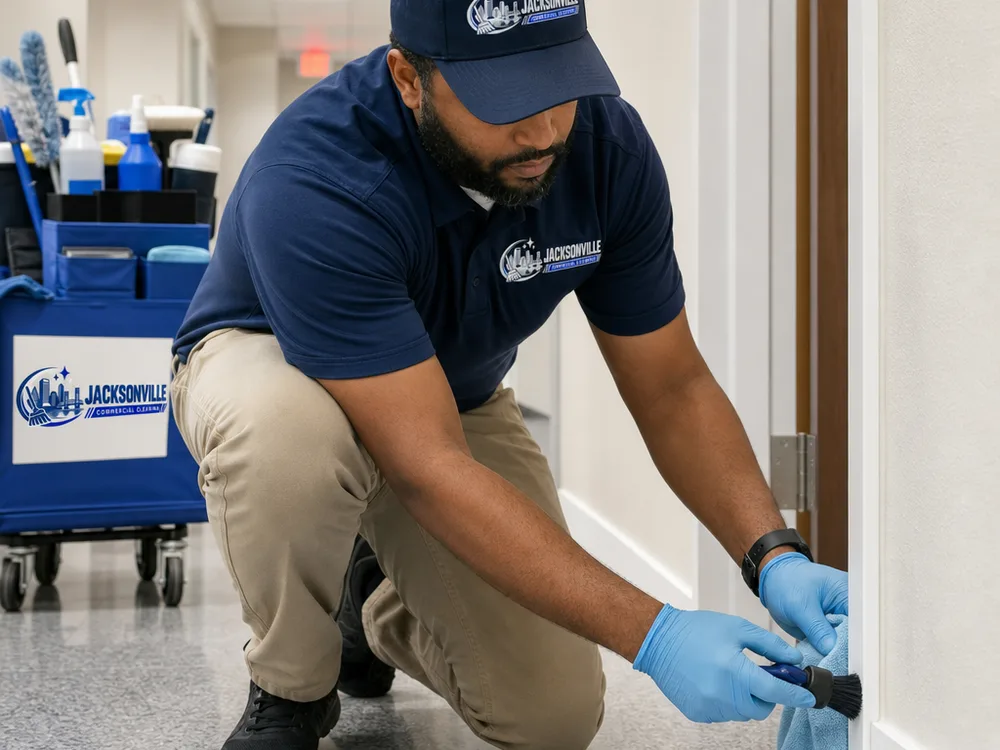
Technician detail-cleaning baseboards and door frames in a commercial hallway
Clear glass, clean frames

Window Cleaning Services in Jacksonville FL

Storefront glass is the first thing a customer reads about your business. We clean commercial glass inside and out, along with the frames, tracks and sills that make clean windows actually look clean.

✓Storefront and entry glass
✓Frame and track detail
✓Interior partition care
✓Rotation scheduling available
Streaks usually start elsewhere

Why clean glass still looks dirty

Most complaints about window cleaning are not really about the glass. Grit left in a track reappears on the pane with the next rain. A dusty frame runs dirty water down a clean sheet. A sill full of pollen sends it all back up the moment a door swings open and the air moves.

Treating the whole opening is what prevents that: glass on both faces where access allows, frames wiped, tracks cleared, sills detailed, and hard-water spotting addressed before it has a chance to etch. Doing the surround first also means the pane is the last thing touched, which is the only reliable way to leave it clear at the angle your customers see it from.

Local conditions set the pace here. Salt air near the coast, summer storm spray, irrigation overspray and a heavy spring pollen season each leave a different mark on glass, and each returns on its own timetable rather than a convenient shared schedule.

Request a Callback
Glass we handle

Commercial window cleaning services

What this covers in practice, from storefront and display glass, entryways and vestibules through the rest of the list below, each with the detail that matters on site.

Request a Callback

Storefront and display glass

Retail frontage carries fingerprints, product tape residue, promotional adhesive and the lower-panel smudging that comes from doors being pushed all day. Service covers both faces, plus door glass, push plates and the metal framing bordering the display.

Entryways and vestibules

Entry doors meet every hand that comes through a building. Vestibule glass, sidelights, transoms and the awkward panels flanking a sliding or revolving door are detailed, along with thresholds and tracks where grit collects and then grinds.

Interior glass and partitions

Open-plan offices are full of glass nobody has a plan for: conference room walls, office fronts, sidelights, feature panels and glass doors. These are cleaned without wetting carpet or furniture, then polished out so no haze shows up on a video call.

Low-rise building exteriors

Exterior glass within safe reach from the ground or a pole system is cleaned on a rotation suited to the building's exposure. Water-fed poles handle height using purified water, so panes dry without spotting, and the reach we can achieve is confirmed before quoting.

Frames, tracks and sills

Each opening has its surround cleaned, not only the pane: frame faces, gaskets, track channels, weep holes and sills. Clearing them keeps the next rain from redrawing the dirt you just paid to remove, and it stops sliding doors from binding.

Hard water and film removal

Sprinkler overspray, irrigation mist and leftover mortar splash leave mineral deposits that ordinary washing walks straight past. Where a deposit sits on the surface, restorative treatment lifts it. Where it has etched into the glass, you hear plainly how the pane will look afterward.

Deciding reach and rhythm

Setting scope and frequency for glass

Scope on a glass job is counted in panes and sides, never in square footage. The walk records how many openings a building has, whether both faces of each one can be reached, what every surround needs, and which panels call for a pole, a ladder or interior access through a tenant's suite.

Frequency then follows exposure. A restaurant door and a storefront on a busy corridor want frequent attention, interior partitions can run on a longer cycle, and coastal buildings need a tighter rotation because salt film builds faster there.

Rotations can mix, which is how most buildings end up buying this: entry glass on a short cycle, everything else periodically, and an extra visit before an event or an inspection when the calendar calls for it. The written scope names each cycle so nobody has to guess what a given visit included.

Request a Callback
Commercial cleaners vacuuming and wiping high-touch surfaces in a modern Jacksonville office suite
How a glass visit runs

Our window cleaning process

What this covers in practice, from count and access check, surround cleaned first through the rest of the list below, each with the detail that matters on site.

Request a Callback
01

Count and access check

Openings are counted by pane and by side, and access is tested rather than assumed. Locked rooms, parked vehicles, planted beds, awnings and roof equipment all decide what can be reached and what needs a different arrangement.

02

Surround cleaned first

Work opens on the dry debris: tracks vacuumed or brushed, sills cleared, frames wiped, cobwebs and nests taken out of the corners. Starting there means nothing runs back onto the pane once water is involved.

03

Glass washed and finished

Panes are washed by whichever method the location calls for, squeegeed or pole-rinsed, then edges and corners dried wherever streaking shows. Interior work uses controlled moisture so nothing drips onto sills, carpet or electronics below.

04

Spot and film treatment

Anything surviving a normal wash gets named: mineral spotting, adhesive, paint flecks, construction haze. Surface deposits are treated where the glass allows it, and permanent etching is pointed out so you know what you are looking at.

05

Final look from outside

The last check happens from where your customers stand, at the angle sunlight shows every miss. Remaining haze or runs are reworked, and the visit closes with a note of anything the building needs: a failed seal, a cracked pane, a loose gasket.

Glass around the city

Window cleaning across Jacksonville

Storefront rotations run heavily in San Marco, Riverside and Downtown, where ground-level retail and restaurants sit on busy sidewalks. Southside and Baymeadows bring low-rise offices with large interior glass, Mandarin and Orange Park bring strip-center frontage, and Arlington and Northside add industrial and service buildings with high shop glass.

Along Jacksonville Beach, salt film returns faster than anywhere inland, so those buildings tend to want a shorter cycle and closer attention to frames and gaskets, where corrosion starts long before anyone notices the glass.

Offices that would rather have their glass handled inside a wider cleaning plan can fold it into our office cleaning services instead of booking and tracking a separate visit.

Cost comes down to access

What window cleaning costs in Jacksonville

Glass pricing is built from pane count, how many sides are cleaned, and how hard each is to reach. Ground-level storefront moves quickly, while upper panes needing a pole system, interior access through occupied suites, or a visit scheduled before opening hours all take longer.

What the final figure depends on is the rest of the detail: surround and track condition, screens that come out and go back, mineral treatment on spotted panes, and how often the rotation runs. A walkthrough and a pane count produce the quote.

Request a Callback
What store owners ask

Window cleaning questions

Answers to what buildings ask before they arrange a walkthrough, covering scope, scheduling and how the work gets checked.

How often should commercial windows be cleaned?

Exposure decides the interval. A restaurant or retail door with constant hand contact looks poor within days, so frequent service pays for itself. Offices with glass set back from the sidewalk hold up for weeks. Coastal buildings, and anything near irrigation, want tighter intervals because salt and minerals build quietly before they show.

Do you clean both the inside and the outside?

Both faces are standard wherever access allows, since cleaning one side only moves the problem. Interior panes need rooms unlocked and furniture clear, so occupied suites are coordinated in advance. Exterior work is governed by safe reach, which gets confirmed while the openings are counted.

Can you remove hard water spots from glass?

Often, depending on how long the deposit has been sitting there. Fresh mineral residue from sprinklers or irrigation rests on the surface and answers to restorative treatment. Deposits left through many cycles of heat and sun can etch the glass itself, which no cleaning reverses. Each pane is assessed and you hear which category it falls into.

What height can you reach?

Ground-level and low-rise glass is routine, worked from the ground with water-fed poles or from safe ladder positions. Anything above that is discussed openly during the walk, including which portion of the building we can take on and what the remaining panes would need. The reach is in writing before a schedule is set.

Are frames, tracks and screens included?

Frames, tracks and sills are included, because leaving them undone makes the glass look dirty again at the first rain. Screens can be removed, cleaned and refitted as part of the scope in buildings that have them. All of this is named in the written scope, so there is no question later about what the visit covered.

Will you work before opening or after closing?

Scheduling around trading hours is normal for storefronts and restaurants: early morning before customers arrive, or once the doors are locked. Interior office glass often suits evenings. The visit fits your hours and your access arrangements rather than asking you to work around a fixed route.

Get a pane count and quote

Tell us where the building is, what glass it has and how often you want it looking sharp. We will count the openings, confirm what we can reach, and put the rotation and the price in writing.

Request a quote

Tell us about your facility

Send the building type, the areas that matter most and your preferred service window, and we will follow up to arrange a walkthrough.